
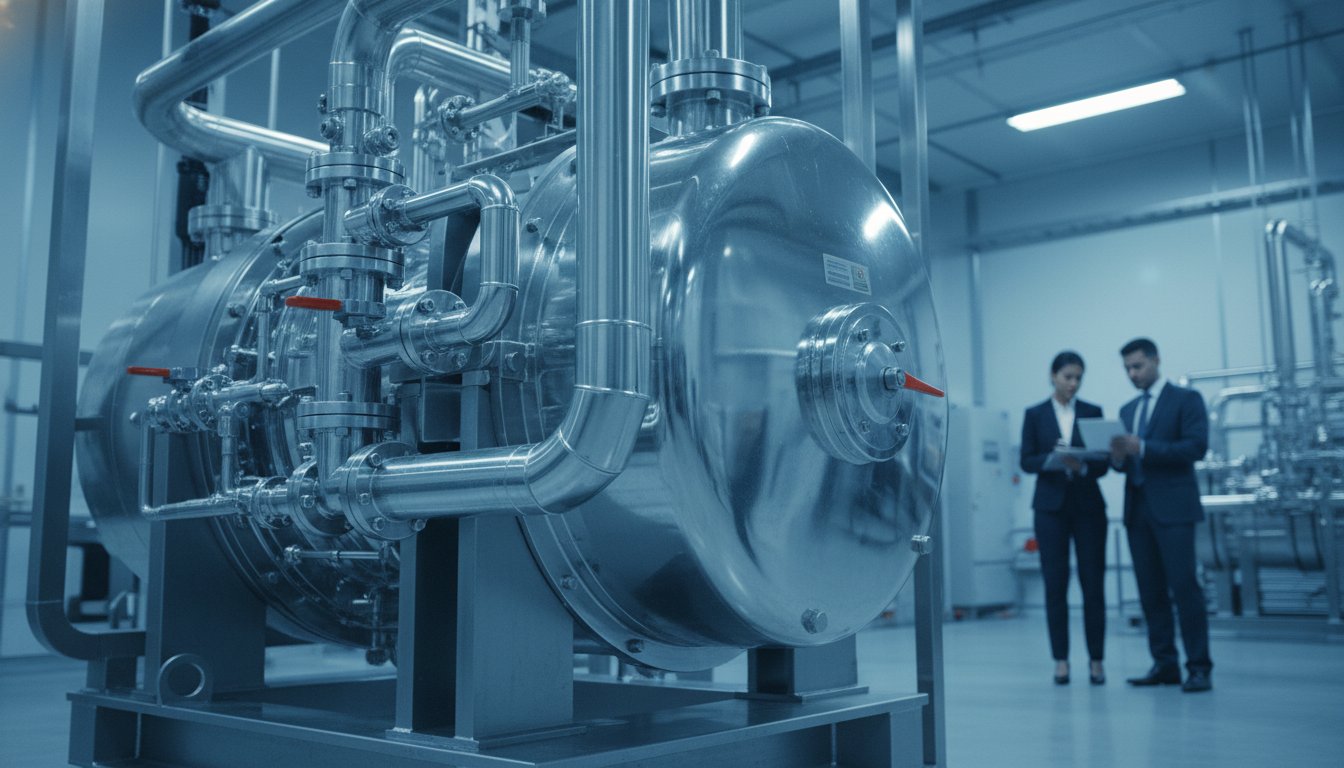
While compressors accounted for 36.18% of the industrial refrigeration system market share in 2025, their impact on operational longevity far outweighs their initial capital cost. Most facility engineers understand that a flawed industrial refrigeration compressor manufacturer selection process leads to more than just high energy consumption; it creates significant vulnerabilities regarding ammonia leakage and premature component wear. You’re likely aware that the structural integrity of these units is the primary defense against the catastrophic failure of complex industrial infrastructure.
This guide serves as a technical evaluation framework to assist you in vetting manufacturers based on rigorous engineering standards and material science. We’ll outline a reliable procurement checklist that focuses on metallurgical precision, advanced machining tolerances, and the strict safety protocols required for modern ammonia systems. By analyzing these critical benchmarks, you can ensure your chosen partner possesses the technical mastery necessary to support high-performance cooling requirements while maintaining compliance with 2026 environmental regulations.
Key Takeaways
- Evaluate how a disciplined industrial refrigeration compressor manufacturer selection process directly influences long-term operational expenditure and system-wide energy efficiency.
- Analyze metallurgical standards and precision machining tolerances to ensure the structural integrity and volumetric performance of pressure-retaining components.
- Verify manufacturer expertise in ammonia-specific safety, focusing on the exclusion of incompatible materials and the integration of specialized ammonia valves.
- Establish rigorous vetting protocols for manufacturing infrastructure, prioritizing in-house testing capabilities such as hydrostatic and helium leak verification for maximum reliability.
- Understand the technical advantages of sourcing from a partner capable of supporting complex infrastructure through the integrated production of condensers, evaporators, and refrigerant vessels.
The Strategic Importance of Industrial Refrigeration Compressor Manufacturer Selection
The compressor serves as the primary mechanical heart of any heavy-duty cooling infrastructure, driving the continuous movement of refrigerant necessary to sustain critical thermal gradients. In large-scale industrial facilities, this component is responsible for maintaining the pressures required for the Vapor-compression refrigeration cycle to function effectively. A disciplined industrial refrigeration compressor manufacturer selection process is not merely a procurement task; it is a strategic decision that dictates the operational trajectory of a facility for decades. A manufacturer that prioritizes structural integrity and technical rigor ensures that the entire pressure system remains stable under fluctuating load conditions, positioning the business as a reliable partner rather than a simple hardware vendor.
Impact on System Longevity and Reliability
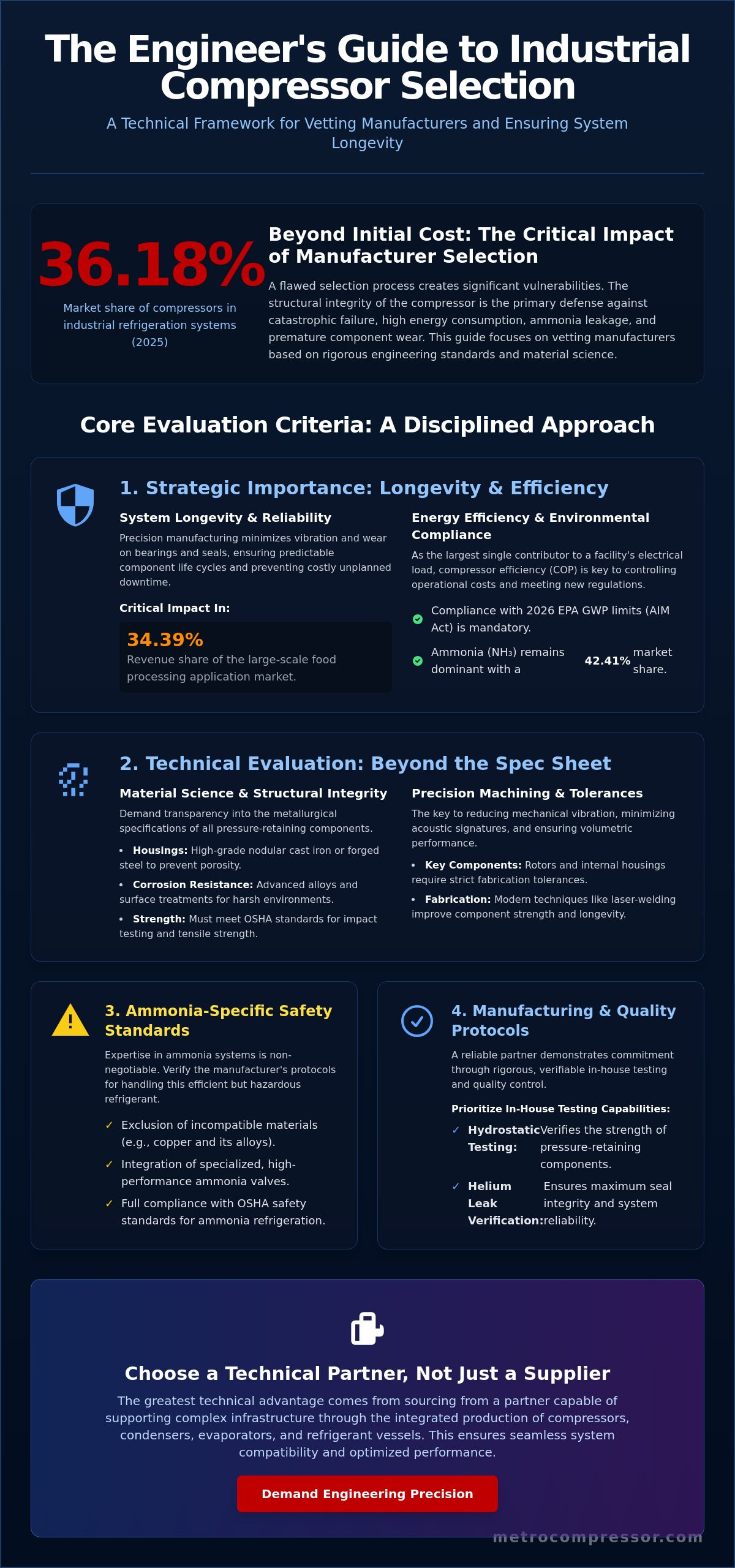
Mechanical reliability is directly proportional to the precision of the manufacturing process and the quality of the raw materials utilized. In sectors like large-scale food processing, which accounted for a 34.39% revenue share of the application market in 2025, the financial impact of unplanned downtime is often catastrophic. Engineering precision in the fabrication of rotors and internal housings reduces mechanical vibration and minimizes acoustic signatures. This technical discipline prevents the accelerated wear of bearings and seals, ensuring that component wear cycles remain predictable. By adhering to strict manufacturing tolerances, a manufacturer provides the stability required to avoid the premature failure of complex industrial infrastructure.
Energy Efficiency and Environmental Responsibility
Because compressors accounted for 36.18% of the industrial refrigeration system market share in 2025, they represent the largest single contributor to a facility’s electrical load. A manufacturer’s commitment to optimizing the Coefficient of Performance (COP) is essential for controlling long-term operational expenditure. As of January 1, 2026, the EPA has implemented new GWP limits under the AIM Act, making the transition to natural refrigerants a regulatory necessity. Ammonia continues to be a dominant refrigerant, holding a 42.41% market share due to its superior thermodynamic properties. A technically proficient manufacturer understands how to maximize these efficiencies through sophisticated machining and the integration of high-performance ammonia valves, ensuring the system remains both compliant and cost-effective in high-capacity applications.
Ultimately, the value of a technical partnership outweighs the benefits of a low-cost hardware transaction. A manufacturer that provides transparency into their engineering standards and quality protocols allows for the verification of safety compliance before the equipment is even installed. This level of detail-oriented production is what separates a standard supplier from an authoritative expert in industrial cooling.
Technical Evaluation Criteria: Beyond the Spec Sheet
A sophisticated industrial refrigeration compressor manufacturer selection process demands a deep dive into the metallurgical specifications of pressure-retaining housings and internal rotating assemblies. While standard spec sheets provide nominal capacity data, they often omit the granular details of material science that dictate how a unit performs under the thermal stresses of continuous operation. Superior manufacturing relies on high-grade nodular cast iron or forged steel for compressor housings to prevent porosity and ensure structural stability under high-pressure loads. For systems utilizing natural refrigerants, adhering to OSHA safety standards for ammonia refrigeration is non-negotiable; this involves verifying that all pressure-retaining components meet strict impact testing and tensile strength requirements.
Material Science and Structural Integrity
The choice of alloys and the application of surface treatments are critical for corrosion resistance in harsh industrial environments. Laser-welded components are increasingly utilized for their ability to maintain airtight seals in high-pressure environments without the thermal distortion associated with traditional welding. The integration of pillow plate technology in modern heat exchange systems allows for more efficient thermal transfer, which reduces the overall load on the compressor. Evaluating these technical nuances ensures that your industrial cooling infrastructure remains resilient against premature mechanical fatigue and structural degradation.
Advanced Machining and Assembly Standards
Precision machining is the foundation of volumetric efficiency. CNC manufacturing of rotors and pistons must achieve tolerances measured in microns to minimize gas bypass and internal friction. High-speed rotary components require dynamic balancing to eliminate mechanical vibration, which otherwise leads to bearing failure and acoustic pollution. The assembly environment itself must be a controlled space; maintaining low humidity and high cleanliness prevents internal contamination that can degrade lubrication quality.
A meticulous manufacturer will also provide verification of seal integrity and shaft alignment protocols, ensuring that the unit is ready for the rigors of heavy-duty service as part of a comprehensive industrial refrigeration compressor manufacturer selection strategy. Proper lubrication system design, featuring optimized oil return and cooling paths, remains the final safeguard against component wear. These internal standards are what distinguish an engineered solution from a generic commodity.
Ammonia-Specific Considerations and Safety Standards
Ammonia remains the industry standard for high-capacity cooling due to its superior thermodynamic properties, yet its chemical reactivity requires a specialized approach to material science. A successful industrial refrigeration compressor manufacturer selection process must prioritize the absolute exclusion of copper and brass, as these materials experience rapid corrosion when exposed to ammonia. Manufacturers must instead utilize high-grade carbon steel or stainless steel for all wetted parts, including the internal components of refrigerant vessels and piping. This commitment to material compatibility is a primary requirement for compliance with OSHA ammonia refrigeration safety standards, which govern the design and operation of these high-pressure systems.
Ammonia Valve Integration and Control
The integration of specialized ammonia valves is a critical factor in maintaining system stability. These valves must provide reliable shutoff and precise pressure regulation to prevent the accumulation of liquid refrigerant in the compressor suction line. Choosing a partner who manufactures their own ammonia-ready hardware ensures that the valve stations are optimized for the specific flow characteristics of the compressor. This technical synergy reduces unnecessary pressure drops and enhances the overall efficiency of the vapor-compression cycle. It is also essential to evaluate how these valves are tested for leak containment, as the safety of the facility depends on the integrity of every seal and gasket. Manufacturers who maintain control over their hardware production can guarantee that their ammonia valves meet the same metallurgical standards as the compressor itself.
Vessel Design and Refrigerant Management
Effective liquid management relies on the structural integrity of refrigerant vessels and accumulators. These components must be designed to handle the surge volumes associated with large-scale industrial loads. Advanced designs, such as falling film chillers, allow for a significant reduction in the total ammonia charge, which lowers the potential risk during a leak event. Manufacturers should provide documentation regarding the hydrostatic testing and material traceability of their evaporative condensers and evaporators. By ensuring that these vessels are manufactured to the same rigorous standards as the compressor, engineers can prevent the stress corrosion cracking that often leads to premature system failure. Evaluating these safety-critical components is a fundamental step in a comprehensive industrial refrigeration compressor manufacturer selection strategy that prioritizes long-term facility safety and operational discipline.
Assessing Manufacturing Infrastructure and Quality Protocols
A comprehensive industrial refrigeration compressor manufacturer selection framework requires a rigorous audit of the physical infrastructure where these units are fabricated. It’s not enough to review a finished product; an engineer must understand the lifecycle of quality assurance that precedes assembly. Sophisticated manufacturers invest heavily in in-house testing capabilities, including performance benches that simulate real-world load conditions and hydrostatic chambers for pressure-retaining components. Helium leak testing represents the gold standard for ensuring system tightness, as it detects microscopic pathways that traditional bubble tests would overlook. This level of technical transparency provides the security required for high-risk industrial environments where ammonia containment is paramount.
Traceability remains a cornerstone of industrial reliability. Meticulous manufacturers maintain detailed records of material origins, ensuring that every forged rotor and cast housing has a documented metallurgical history. This prevents the introduction of counterfeit or substandard alloys that could lead to catastrophic failure under stress. Compliance with international pressure vessel codes, such as those established by ASME, serves as a baseline certification that confirms the manufacturer’s commitment to global engineering standards. Furthermore, a manufacturer’s investment in Research and Development (R&D) indicates a forward-thinking approach to cooling technology, ensuring that their equipment remains compatible with evolving efficiency mandates and refrigerant regulations.
The Quality Assurance (QA) Audit Process
The verification of structural integrity begins with non-destructive testing (NDT) for all critical welds on the compressor housing and associated refrigerant vessels. These reports, which include X-ray or ultrasonic data, confirm the absence of internal slag or voids that could compromise the system under pressure. Precision measurement tools must undergo frequent calibration to maintain the micron-level tolerances required for high-speed components. A final Factory Acceptance Test (FAT) serves as the ultimate assurance of quality; the unit is operated under controlled conditions to verify that all performance benchmarks and safety parameters are met before it leaves the facility.
After-Sales Engineering and Technical Support
The value of a manufacturer is often defined by their responsiveness after the initial hardware transaction is completed. Technical documentation must be exhaustive, providing detailed spare parts lists and maintenance manuals that facilitate long-term reliability and minimize system downtime. Manufacturer-led training for on-site operators is essential to ensure that the complex machinery is handled according to engineering specifications. When complex troubleshooting is required, the availability of a technically proficient engineering support team is the difference between a minor adjustment and prolonged system failure. For those seeking a partner committed to these rigorous standards, you can review our engineering and manufacturing protocols to see how precision is maintained throughout the production lifecycle.
The Metro Compressor Approach: Engineering Precision in Industrial Cooling
Metro Compressor stands as a veteran manufacturer dedicated to the internal integrity and long-term functionality of heavy-duty machinery. When conducting an industrial refrigeration compressor manufacturer selection audit, engineers often find that fragmented supply chains introduce hidden risks through component incompatibility. We mitigate these variables by maintaining total control over the manufacturing lifecycle of our ammonia refrigeration compressors. This disciplined approach ensures that every unit leaving our facility adheres to the same stringent metallurgical and machining standards discussed throughout this technical evaluation framework. We don’t just supply hardware; we provide the engineering stability required to support the world’s most demanding cooling applications.
Comprehensive Industrial Cooling Solutions
We manufacture a full suite of hardware designed to operate as a cohesive and reliable pressure system. Our integrated production capabilities include:
- High-performance Ammonia valves designed for precise pressure regulation and leak containment.
- Refrigerant Vessels and Evaporators manufactured with full material traceability and rigorous hydrostatic testing.
- Evaporative Condensers and Pillow Plates that maximize thermal transfer efficiency in harsh environments.
- Falling Film Chillers engineered specifically to optimize ammonia charge reduction and enhance facility safety.
By sourcing these critical components from a single engineering entity, facility operators avoid the technical discrepancies common with third-party hardware. This unified model ensures that the performance benchmarks of the heat exchangers and vessels are perfectly aligned with the compressor’s volumetric capacity.
Partnering with Metro Compressor
Our identity is defined by a commitment to high-level industrial standards and a grounded, professional address. We support large-scale applications in the food processing sector, providing durable IQF systems and Industrial Ice Banks that sustain rigorous production schedules. These systems rely on our technical mastery of material science to resist the mechanical fatigue associated with high-speed operations. We prioritize substance and exhaustive testing over superficial industry trends, ensuring that our global clients receive infrastructure built for longevity and structural durability. If you’re designing a new facility or upgrading existing cooling infrastructure, we invite you to contact our engineering team for specialized refrigeration consultation to discuss how our manufacturing rigor can enhance your operational reliability.
Securing Long-Term Performance Through Technical Mastery
Successful industrial refrigeration compressor manufacturer selection requires a meticulous audit of metallurgical standards and in-house testing protocols. It’s essential to verify that pressure-retaining components meet strict impact testing requirements while ensuring that all wetted parts are compatible with natural refrigerants like ammonia. By prioritizing technical mastery over superficial market trends, facility operators can secure the structural integrity of their entire cooling infrastructure for decades of reliable service. This disciplined approach to procurement prevents the mechanical vulnerabilities that lead to unplanned downtime and excessive energy consumption.
As a specialized manufacturer of ammonia compressors and high-performance valves, Metro Compressor maintains a disciplined production cycle that includes the in-house fabrication of refrigerant vessels and falling film chillers. Our role as a global supplier of evaporative condensers and IQF systems allows us to support complex industrial projects with a unified engineering approach that eliminates component incompatibility. This technical synergy ensures that every piece of hardware operates at peak volumetric efficiency within your facility.
Consult with Metro Compressor Engineers for Your Next Industrial Cooling Project to ensure your system meets the highest safety and efficiency standards. We look forward to supporting your commitment to industrial excellence and engineering precision.
Frequently Asked Questions
What are the most critical factors when selecting an industrial refrigeration compressor manufacturer?
The most critical factors in a successful industrial refrigeration compressor manufacturer selection process include the manufacturer’s metallurgical standards, precision machining capabilities, and the rigor of their in-house quality assurance protocols. Engineers must prioritize structural integrity and material traceability to ensure the equipment survives the high-pressure demands of heavy-duty industrial infrastructure. A manufacturer’s ability to provide detailed engineering documentation and technical support is equally vital for long-term operational stability.
Why is ammonia the preferred refrigerant for large-scale industrial applications?
Ammonia is preferred for large-scale applications due to its superior thermodynamic properties and its status as a natural refrigerant with a Global Warming Potential (GWP) of zero. It held a 42.41% market share in 2025 because it offers a higher coefficient of performance (COP) compared to synthetic alternatives. This efficiency makes it the most cost-effective choice for high-capacity food processing and cold storage facilities that must comply with 2026 environmental regulations.
How do I verify the manufacturing quality of an industrial compressor?
Verifying manufacturing quality involves reviewing non-destructive testing (NDT) reports for critical welds and confirming that CNC machining achieves micron-level tolerances for rotors and housings. You should also evaluate the final factory acceptance test (FAT) procedures to ensure the unit meets all performance benchmarks before shipment. A transparent manufacturer will provide access to their inspection lifecycle, from initial material sourcing to final hydrostatic and helium leak testing.
What is the role of a falling film chiller in an ammonia refrigeration system?
A falling film chiller functions as a high-efficiency heat exchanger that allows for a significant reduction in the total ammonia charge within a system. By distributing refrigerant in a thin film over the heat exchange surface, it optimizes thermal transfer while enhancing facility safety through lower refrigerant volumes. This technology is particularly valuable in industrial settings where reducing the risk of a large-scale leak is a primary safety objective.
How does the design of ammonia valves impact system safety and efficiency?
The design of ammonia valves is central to system safety as these components provide critical shutoff and precise pressure regulation. Utilizing specialized, ammonia-ready valves reduces internal pressure drops, which directly improves the volumetric efficiency of the compressor. Properly engineered valves also prevent dangerous liquid slugging, ensuring that the refrigeration cycle remains stable and that the system complies with OSHA safety standards.
What certifications should I look for in an industrial refrigeration equipment manufacturer?
You should look for manufacturers that adhere to international standards such as the ASME Boiler and Pressure Vessel Code and maintain ISO certifications for quality management. Compliance with OSHA safety standards for ammonia refrigeration is also a non-negotiable requirement for ensuring legal and operational safety. These certifications serve as a baseline verification of the manufacturer’s commitment to rigorous engineering and safety protocols.
How can I optimize the energy efficiency of my industrial refrigeration plant?
Optimizing energy efficiency requires the integration of variable speed drives (VSD) and the use of high-performance components like evaporative condensers and pillow plates. These technologies allow the system to adjust to partial-load conditions while maintaining a high coefficient of performance, which reduces long-term operational expenditure. Regular maintenance of the compressor’s internal tolerances also ensures that volumetric efficiency doesn’t degrade over time.
What is the importance of refrigerant vessels and accumulators in system design?
Refrigerant vessels and accumulators are essential for managing liquid surges and ensuring that only dry vapor enters the compressor suction line. Their structural integrity and proper sizing prevent mechanical damage from liquid carryover, which is a primary cause of premature compressor wear. These vessels must be manufactured to the same rigorous standards as the compressor to maintain the integrity of the high-pressure system.