
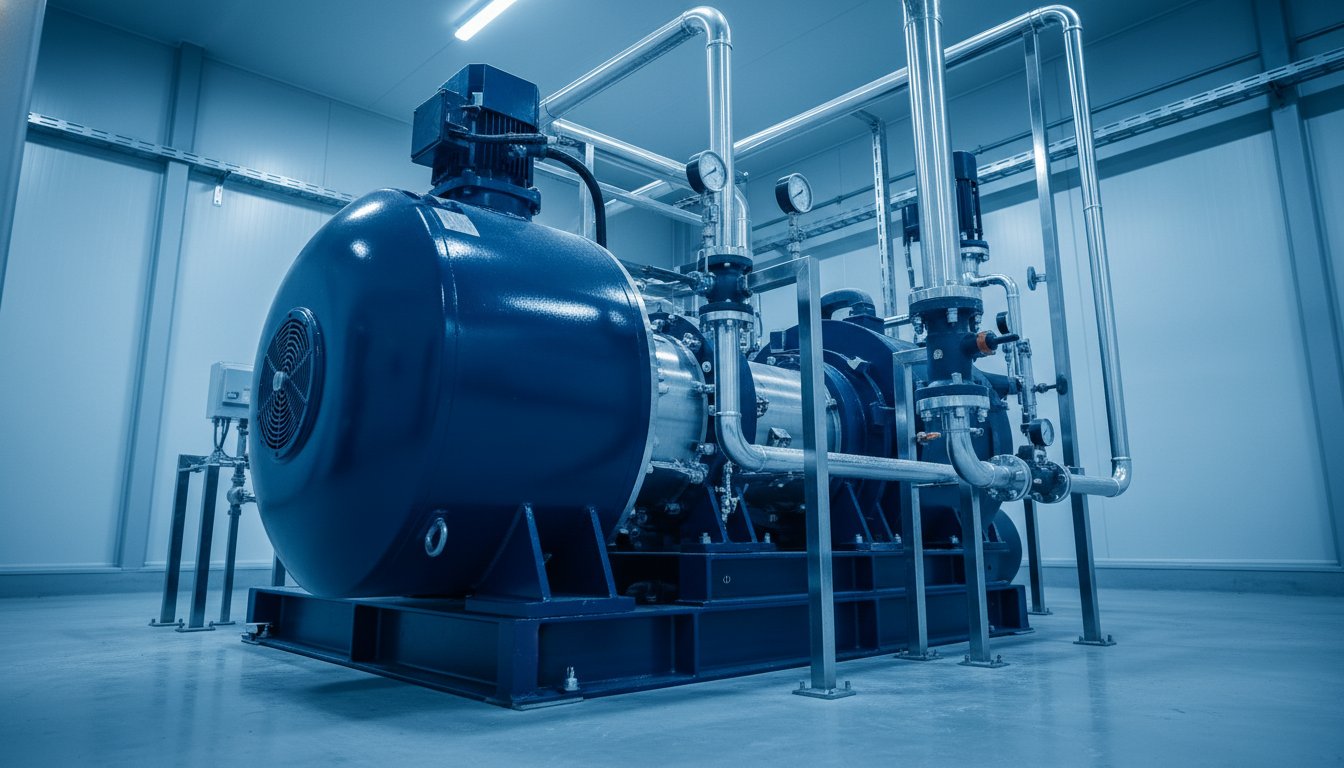
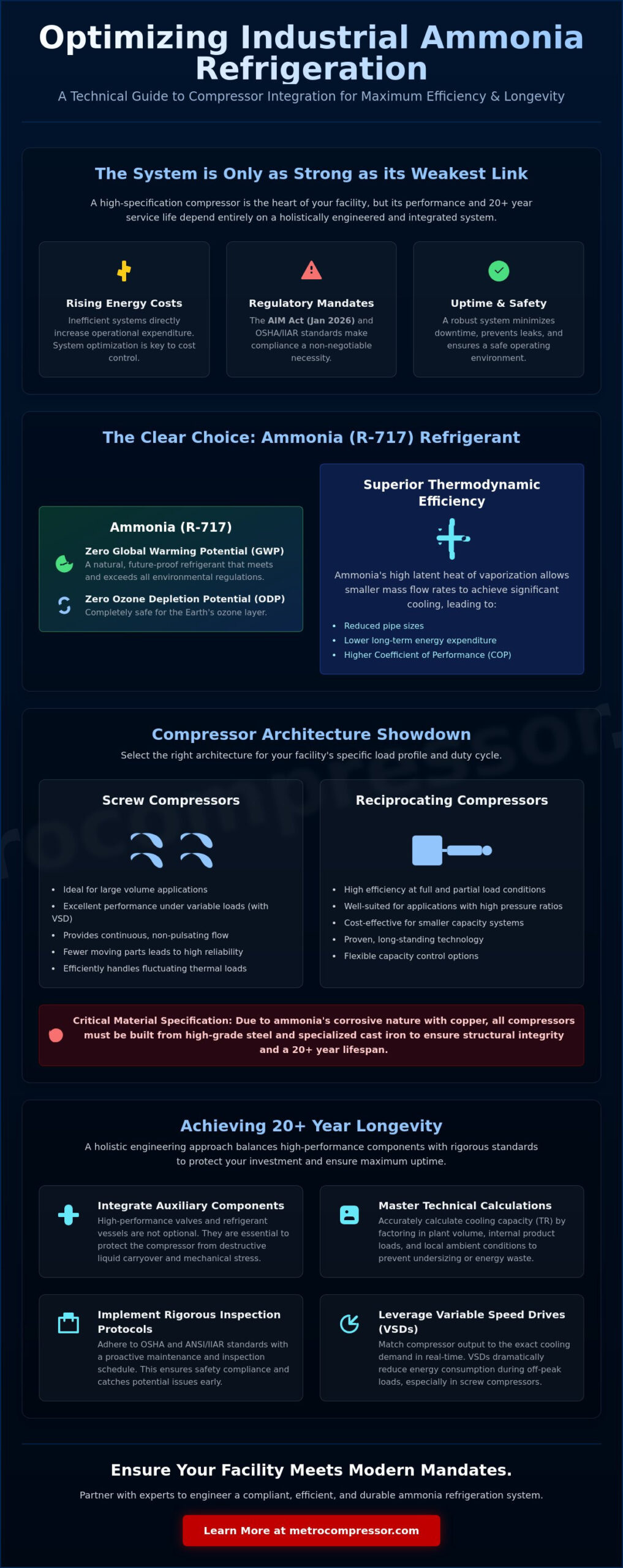
The long-term viability of a large-scale cooling plant often hinges on a single decision that many operators overlook: the assumption that a high-spec compressor can compensate for a poorly integrated system. While industrial ammonia refrigeration compressors serve as the mechanical heart of the facility, their ability to deliver thermodynamic efficiency and maintain a twenty-year service life depends entirely on the structural integrity of the surrounding components. You likely recognize that rising energy costs and the stringent Global Warming Potential limits introduced by the January 2026 AIM Act revisions have made system optimization a regulatory necessity rather than a choice.
This technical guide provides a detailed analysis of how to specify and integrate high-performance ammonia compressors to achieve maximum uptime and safety compliance. We will examine the specific mechanical requirements of reciprocating and screw models, evaluate the impact of variable speed drives on energy consumption, and outline the rigorous inspection protocols required by OSHA and ANSI/IIAR standards. By focusing on meticulous manufacturing standards and sophisticated infrastructure, you can ensure your facility meets modern environmental mandates while minimizing the risk of costly maintenance downtime.
Key Takeaways
- Identify the mechanical distinctions between screw and reciprocating compressor architectures to ensure the selected unit aligns with your facility’s specific load requirements and operational duty cycles.
- Evaluate the thermodynamic efficiency of industrial ammonia refrigeration compressors compared to synthetic alternatives to maximize your Coefficient of Performance and reduce long-term energy expenditure.
- Master the technical calculations for cooling capacity (TR) by factoring in plant volume, internal product loads, and the impact of local ambient conditions on system sizing.
- Extend equipment service life by integrating auxiliary components such as high-performance ammonia valves and refrigerant vessels that protect the compressor from liquid carryover and mechanical stress.
- Implement a holistic engineering approach that balances regulatory compliance with structural integrity to achieve a target system longevity exceeding twenty years.
The Critical Role of Ammonia Refrigeration Compressors in Industrial Infrastructure
Industrial ammonia refrigeration compressors act as the primary mechanical drivers within the vapor-compression cycle, converting electrical energy into the pressure differentials required for continuous heat transfer. Ammonia, designated as R-717, is a natural refrigerant characterized by zero Ozone Depletion Potential (ODP) and zero Global Warming Potential (GWP). Its high latent heat of vaporization means that smaller mass flow rates can achieve significant cooling capacities, which directly translates to reduced pipe sizes and lower operational costs for large-scale facilities. While the refrigerant provides the thermal medium, the compressor determines the overall plant energy efficiency through its management of compression ratios. A well-engineered system maintains these ratios within optimal ranges to prevent excessive heat build-up and mechanical wear.
Thermodynamic Principles of Ammonia Compression
The efficiency of an industrial system is heavily influenced by its compression ratio, which is the ratio of discharge pressure to suction pressure. Because ammonia has a high heat of compression, discharge temperatures often reach levels that would degrade standard lubricants or damage internal seals in lesser equipment. This physical reality necessitates the use of specialized materials and integrated cooling mechanisms within the compressor housing to maintain thermal stability. Understanding the Thermodynamic Efficiency and the Case for Ammonia-Based Cooling requires a deep dive into how these compressors manage the transition from low-pressure vapor to high-pressure gas without losing energy to friction or heat leakage. Precise control over these thermal transitions is what separates a standard unit from a high-performance industrial machine.
Industrial Applications: From Cold Storage to Food Processing
In modern food production, industrial ammonia refrigeration compressors are indispensable for powering IQF (Individually Quick Frozen) systems, where rapid temperature drops are required to preserve product texture and safety. Large-scale dairy and meat processing plants often face fluctuating thermal loads; the compressor must respond precisely to these changes to prevent energy waste. Transitioning from synthetic HFCs to ammonia systems provides a clear path toward sustainability while offering superior heat transfer coefficients. This transition isn’t just about environmental compliance. It’s about securing a system that delivers reliable cooling for decades under the most demanding industrial conditions.
Engineering precision is non-negotiable when dealing with R-717. Because ammonia is corrosive to copper and its alloys, all internal components must be manufactured from high-grade steel or specialized cast iron. Rigorous machining tolerances ensure that clearances remain consistent even under the extreme pressure of a heavy-duty cooling cycle. These standards are what guarantee the structural integrity of the hardware, preventing leaks and ensuring that the compressor remains the steadfast heart of the facility infrastructure.
Engineering Specifications: Screw vs. Reciprocating Compressor Architecture
Selecting the appropriate mechanical architecture for industrial ammonia refrigeration compressors requires a technical evaluation of the facility’s load profile and intended operational lifespan. While both screw and reciprocating designs facilitate the vapor-compression cycle, their internal engineering solves different thermodynamic challenges. Material science plays a decisive role in this selection. Because ammonia (R-717) is chemically incompatible with copper, these compressors are manufactured using specialized ferrous alloys, such as high-strength cast iron and forged steel, to ensure long-term structural integrity. Precision machining of rotor profiles and cylinder linings is not merely a manufacturing preference but a necessity for maintaining the tight tolerances required for efficient compression. When selecting industrial ammonia refrigeration compressors for a new installation, engineers must balance the high-volume throughput of screw models against the superior part-load efficiency of reciprocating designs. A rigorous industrial refrigeration compressor manufacturer selection process that evaluates metallurgical precision and machining tolerances is essential before committing to a 20-year investment. If you’re currently specifying hardware for a cold storage project, reviewing the technical data for industrial refrigeration compressors can provide the clarity needed for a 20-year investment. This grounded approach to equipment selection prioritizes substance and long-term functionality over superficial trends.
Screw Compressors: Design for High-Volume Reliability
Screw compressors are designed for continuous, high-capacity cooling where uptime is the primary performance metric. These units utilize intermeshing helical rotors to reduce the volume of ammonia gas. Precision in rotor profiles is critical; even micron-level deviations can lead to internal bypass. To manage high discharge temperatures, these systems employ oil-injection cooling. This oil doesn’t just lubricate; it seals rotor clearances and absorbs compression heat. For energy modulation, modern screw units use slide valve capacity control to match plant loads without the efficiency losses of suction throttling.
Reciprocating Compressors: Precision in Pulsating Loads
Reciprocating compressors are ideal for smaller-scale applications or facilities with variable cooling demands. Their architecture relies on a crankshaft-driven piston arrangement that delivers high volumetric efficiency at high pressure ratios. Engineering focus centers on valve plate design to prevent liquid slugging, which can cause catastrophic mechanical failure. Adhering to standards like Holistic System Integration: Beyond the Standalone Compressor ensures these components remain compliant. Heavy-duty crankshafts and precision-honed cylinder linings ensure these machines withstand pulsating loads for decades.
Thermodynamic Efficiency and the Case for Ammonia-Based Cooling
The selection of a refrigerant for large-scale cooling is a decision that dictates the operational economy of a facility for decades. Ammonia (R-717) consistently outperforms synthetic HFC and HFO alternatives in terms of the Coefficient of Performance (COP), often providing efficiency gains between 3% and 10% depending on the specific application and ambient conditions. These gains are a direct result of ammonia’s superior thermodynamic properties, which reduce the mechanical workload on industrial ammonia refrigeration compressors. While the initial capital investment for an ammonia system may be higher due to the requirement for stainless steel or high-grade iron components, the total cost of ownership (TCO) over a 20-year lifecycle is significantly lower. This reduction is driven by lower annual energy expenditures and the minimal cost of the refrigerant itself compared to increasingly expensive and regulated synthetic gases.
Heat Transfer Efficiency and Power Consumption
Ammonia’s high latent heat of vaporization allows for exceptionally efficient heat exchange within the evaporators and condensers, which minimizes the pressure lift required from the compressor. By optimizing compression stages and utilizing economizers in screw compressor circuits, engineers can drastically reduce operational expenses (OPEX). Because of its high thermal capacity, ammonia requires less mass flow than synthetic refrigerants to achieve the same cooling capacity. This reduced mass flow translates to lower parasitic power losses and allows for more compact piping infrastructure without sacrificing thermal performance. When industrial ammonia refrigeration compressors operate within these optimized parameters, the resulting energy profile supports both environmental sustainability and bottom-line profitability.
Safety Engineering and Leak Prevention
Engineering for safety is an integral part of the thermodynamic design, requiring a disciplined approach to refrigerant containment and pressure management. For facilities prioritizing long-term stability, Selecting High-Capacity Compressors for Industrial Applications involves a rigorous assessment of both thermodynamic performance and the safety protocols required to manage a high-pressure anhydrous ammonia system. High-performance Ammonia valves and relief systems are essential for isolating sections of the plant during maintenance and preventing over-pressurization. Furthermore, the integration of sophisticated oil separators is vital for maintaining ammonia purity, as oil carryover can coat heat transfer surfaces and degrade the system’s COP. Properly specified Refrigerant Vessels and accumulators act as the final line of defense, protecting the compressor from liquid slugging while ensuring the loop remains sealed and secure under all load conditions.
The transition to ammonia isn’t merely a response to regulatory pressure; it’s a strategic engineering move toward technical mastery. By focusing on the internal integrity of the machinery and the precision of the supporting infrastructure, industrial operators can secure a cooling solution that remains efficient and compliant well into the 2040s. Meticulous testing and the use of heavy-duty materials ensure that the system’s longevity matches the durability of the facility it supports.
Selecting High-Capacity Compressors for Industrial Applications
The process of selecting industrial ammonia refrigeration compressors begins with a rigorous quantification of the plant’s total thermal load, expressed in Tons of Refrigeration (TR). This calculation must account for the specific heat of the product, the enthalpy change required during phase transitions, and the latent heat gains from facility infiltration. Engineers must also evaluate local ambient conditions, as the design wet-bulb temperature directly influences the condensing pressure and, consequently, the compressor’s power consumption. Relying on a single, oversized unit often introduces unnecessary risk; instead, a multi-compressor configuration offers essential redundancy for mission-critical cooling while allowing for precise capacity staging. A disciplined specification process ensures that every component, from the compressor to the supporting Ammonia valves, is sized to handle peak summer loads without compromising system longevity. Applying a structured industrial refrigeration compressor manufacturer selection framework that benchmarks suppliers on material certifications and safety protocols can significantly reduce procurement risk. If you require technical assistance with load calculations or equipment selection, you can consult our engineering team for specialized industrial refrigeration equipment solutions.
Sizing for IQF and Food Processing
In facilities utilizing IQF (Individually Quick Frozen) systems, the compressor must be sized to manage rapid temperature pull-downs and high-velocity airflow loads. These systems often experience fluctuating thermal demands between batch processing and continuous flow, requiring compressors with sophisticated capacity modulation. To improve overall efficiency, Falling Film Chillers are frequently integrated into secondary cooling loops to provide consistent chilled water temperatures, reducing the direct load on the primary ammonia circuit. This integration ensures that the industrial ammonia refrigeration compressors operate within their most efficient performance envelopes even during peak production cycles.
Integration with Evaporative Condensers
The synergy between the compressor and the Evaporative Condenser is a primary determinant of a plant’s energy profile. High condensing pressures, often caused by inadequate condenser sizing or high ambient humidity, force the compressor to work harder, which increases electrical draw and accelerates mechanical wear. By optimizing the head pressure through precise condenser-compressor pairing, operators can maintain lower discharge temperatures and protect the structural integrity of the internal valves and seals. The design must account for the local wet-bulb temperature to ensure the condenser can reject the total heat of compression effectively under all seasonal variations. For a detailed technical analysis of heat rejection system design and its impact on compressor performance, the evaporative condenser for food processing technical guide provides a disciplined framework for achieving lower head pressure and stable condensing temperatures under the 2026 compliance standards.
A comprehensive specification checklist for heavy-duty hardware should include:
- Verification of design suction and discharge pressures across all operating modes.
- Calculated volumetric efficiency at peak and part-load conditions.
- Oil management and separation standards to prevent downstream fouling.
- Material certification for all pressure-retaining components to ensure ammonia compatibility.
- Compatibility with variable speed drives (VFDs) for precise load matching.
Holistic System Integration: Beyond the Standalone Compressor
The long-term functionality of industrial ammonia refrigeration compressors depends on a manufactured ecosystem where every component is engineered to withstand the unique chemical and thermal demands of R-717. A standalone compressor, regardless of its internal precision, cannot maintain system integrity if the surrounding infrastructure fails to regulate flow or manage liquid-vapor separation. Achieving a 20-year service life requires a disciplined approach to integration, ensuring that auxiliary components like Ammonia valves, Refrigerant Vessels, and Evaporators operate in perfect synchronization with the mechanical driver. This holistic strategy prevents the premature wear associated with erratic load swings and ensures the facility remains compliant with safety and environmental regulations.
The Importance of Specialized Ammonia Valves
Standard valves manufactured from copper-based alloys are entirely unsuitable for ammonia environments because the refrigerant causes rapid chemical degradation and catastrophic seal failure. High-performance Ammonia valves must be fabricated from carbon steel or specialized stainless steel to prevent corrosion and ensure precise flow modulation. This precision is vital for maintaining stable suction pressures and preventing the mechanical stress that occurs when compressors are forced to compensate for inconsistent refrigerant flow. Every valve component within the high-pressure loop must undergo rigorous pressure testing to verify its structural integrity and leak-proof performance under extreme operating conditions.
Optimizing the Cooling Loop with Integrated Hardware
The integration of Refrigerant Vessels and suction accumulators provides a critical safety buffer, protecting industrial ammonia refrigeration compressors from liquid carryover. Liquid slugging, even in small volumes, can cause instantaneous damage to compressor rotor profiles or reciprocating valve plates, leading to expensive downtime and significant safety risks. By incorporating surge drums and liquid separators, engineers ensure that only dry vapor enters the compressor inlet. For facilities requiring high-efficiency heat exchange, the use of Pillow Plates and Falling Film Chillers offers superior thermal transfer rates while minimizing the total refrigerant charge. These components, combined with Industrial Ice Banks for peak-load management, create a robust cooling loop that balances thermodynamic performance with operational safety.
Metro Compressor provides these integrated industrial refrigeration solutions by matching technical mastery with a commitment to high-level manufacturing standards. Sourcing your entire cooling infrastructure, from IQF systems to Evaporative Condensers, from a single engineering partner ensures that every connection and control logic is optimized for the specific needs of your facility. This approach moves beyond the purchase of individual parts; it establishes a stable, high-performance infrastructure designed for technical reliability and long-term compliance. By focusing on the internal integrity of the entire system, we help industrial operators achieve superior cooling performance with a focus on durability and precision.
Securing Long-Term Performance through Engineering Precision
The transition toward sustainable cooling infrastructure requires a disciplined focus on the internal integrity of the entire refrigeration loop. Success in large-scale industrial cooling isn’t defined by the compressor alone; it’s the product of the synergy between industrial ammonia refrigeration compressors and the specialized vessels and valves that protect them. By prioritizing meticulous manufacturing standards and exact machining tolerances, operators can achieve the thermodynamic efficiency required to meet modern environmental mandates while ensuring decades of reliable service.
As a specialized manufacturer of ammonia-ready cooling hardware and a global supplier of high-durability refrigerant vessels, Metro Compressor remains a steadfast partner in heavy-duty industrial sectors. Our engineering precision focuses on long-term industrial reliability to help you maintain a competitive edge through technical mastery and stable infrastructure. Consult with our engineering team for high-performance refrigeration solutions to begin optimizing your facility for future-proof reliability. We look forward to supporting your facility’s technical evolution.
Frequently Asked Questions
Why is ammonia preferred over synthetic refrigerants for industrial compressors?
Ammonia remains the superior choice for large-scale cooling due to its exceptional thermodynamic properties and zero environmental impact, as it possesses both zero Global Warming Potential and zero Ozone Depletion Potential. Its high latent heat of vaporization allows industrial ammonia refrigeration compressors to achieve greater cooling capacities with lower mass flow rates than synthetic HFCs. This efficiency directly translates to reduced operational energy costs and ensures long-term compliance with increasingly stringent environmental regulations.
What is the expected lifespan of a heavy-duty industrial ammonia compressor?
A properly specified and maintained heavy-duty industrial compressor typically achieves a service life exceeding 20 years. This longevity is contingent upon the use of high-grade ferrous materials and adherence to rigorous maintenance schedules that prevent mechanical fatigue. Ensuring the structural integrity of the entire cooling loop, including the integration of high-performance ammonia valves, is essential for reaching this multi-decade operational milestone.
How does a screw compressor differ from a reciprocating compressor in ammonia systems?
Screw compressors utilize intermeshing helical rotors to manage continuous, high-capacity cooling loads with minimal vibration and high reliability. In contrast, reciprocating compressors employ a piston-and-cylinder architecture that excels in smaller-scale applications or facilities with highly variable thermal demands. While screw units are favored for their high-volume reliability, reciprocating models often provide superior volumetric efficiency during part-load operations where the plant’s cooling requirements fluctuate.
What are the essential safety features for an ammonia refrigeration compressor?
Essential safety infrastructure includes high-pressure relief valves, sophisticated oil separators, and automated emergency cutout switches that respond to deviations in temperature or pressure. Modern systems also integrate vibration sensors and liquid level controllers within refrigerant vessels to prevent liquid slugging. These features ensure the mechanical heart of the plant remains protected from catastrophic failure while maintaining compliance with OSHA and IIAR safety standards.
How often should industrial ammonia refrigeration maintenance be performed?
Routine inspections of oil levels, filter integrity, and seal conditions should occur on a monthly or quarterly basis depending on the facility’s specific duty cycle. Major mechanical overhauls are typically scheduled based on accumulated operating hours, often ranging from 25,000 to 50,000 hours for screw architectures. Consistent monitoring of ammonia purity and valve performance is critical to preventing the gradual degradation of the system’s Coefficient of Performance.
Can ammonia compressors be integrated with existing napelemes (solar) or green energy systems?
Ammonia compressors are highly compatible with renewable energy sources like solar (napelemes) systems when equipped with Variable Frequency Drives (VFDs) to manage power fluctuations. The inherent efficiency of ammonia reduces the total electrical load, making it easier for green energy arrays to meet the plant’s peak demand. Integrating an industrial ice bank can also allow for thermal energy storage during periods of high solar production, further optimizing the facility’s energy profile.
What role do ammonia valves play in compressor safety and efficiency?
Ammonia valves serve as the primary control mechanism for refrigerant flow, ensuring that the compressor receives a stable supply of dry vapor at the correct suction pressure. High-performance valves also facilitate the isolation of components during maintenance and prevent backflow that could lead to mechanical stress. Their precision directly influences the system’s ability to maintain optimal compression ratios and prevents energy waste through internal leakage.
How do I calculate the cooling capacity needed for an industrial food processing plant?
Calculating required capacity involves determining the total heat load by accounting for product mass flow, specific heat, and the required temperature drop. Engineers must also factor in latent heat gains from facility infiltration, lighting, and personnel, alongside the heat of compression. This total value, expressed in Tons of Refrigeration (TR), dictates the sizing of industrial ammonia refrigeration compressors and the necessary capacity of the evaporative condenser for food processing to ensure the system handles peak production loads.